
Did food and travel platform aggregator companies empower them by ignoring them?
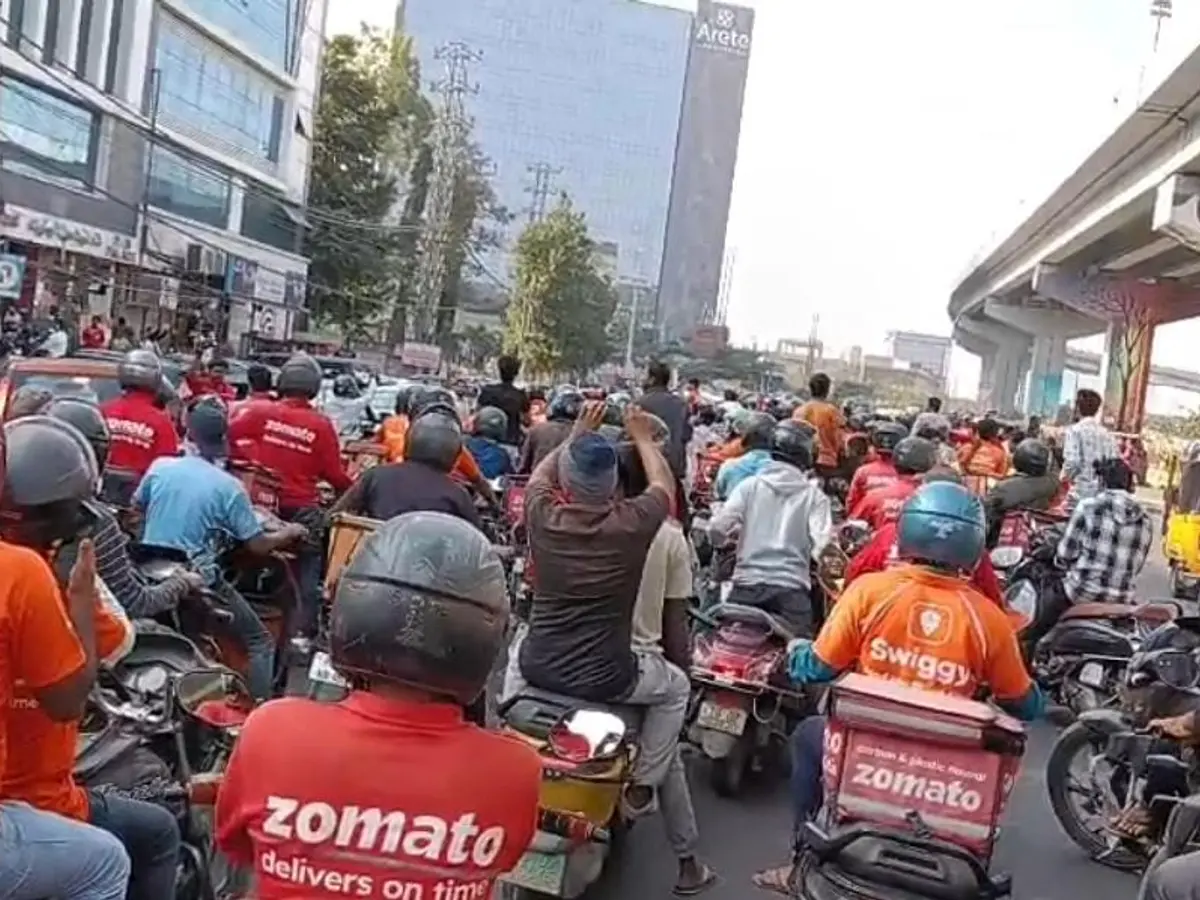
For all big companies, labour is a necessary nuisance. Indian gig workers are the backbone of the country’s e-commerce giants, food delivery apps and app-based transport services. But for over a decade, they have not benefited from the massive profits made by most of these companies. While keeping them as contract workers without any employment benefits, the firms involved seem to have indirectly contributed to their unionising. The firms forgot that the gig worker has the ability to grind businesses to a halt, quite literally. The Christmas day strike, in which some 400,000 gig workers reportedly took part, indicated this. The workers are threatening a similar action on New Year’s Eve. Here is why the gig worker strikes should be taken seriously by the industry.
The delivery workers’ strike: The first shot has been fired, but what do they want?
Delivery workers across India held a nationwide flash strike on Thursday (Dec 25). This was organised by unions like Telangana Gig and Platform Workers Union (TGPWU) and Indian Federation of App-based Transport Workers (IFAT), with solidarity expressed by drivers of food delivery apps. The workers are demanding better wages, safer conditions, social security, transparent pay and respect for rights. They want an end to arbitrary account deactivations without an appeal process, unsafe and ultra-fast delivery demands, and better labour protections. Services were disrupted in several major cities.

The strikes by Ola/Uber/Rapido drivers in July in Mumbai, Pune, Nagpur and in June in Jaipur were led by unions like IFAT and Maharashtra Gig Kamgar Manch. The demands are almost always the same: fixed or higher minimum fares at par with traditional taxis, and caps on platform commissions, transparent ID reactivation and grievance redressal processes.
What are the labour laws governing Indian gig workers?
India’s labour framework for gig workers, including online platform-based workers, is governed by the Code on Social Security, 2020, which was fully implemented on November 21 this year as part of four new consolidated Labour Codes replacing 29 older laws. For the first time, gig workers, who earn outside traditional employer–employee relationships, and platform workers, who perform work via digital platforms, were formally defined and included in this framework.
Under these rules, they are supposed to get life and disability insurance, accident insurance, health and maternity benefits, provident fund (PF), gratuity for fixed-term workers after one year, old-age protection and/or pension. These schemes are to be funded through a social security fund to which platform players are required to contribute 1–2 per cent of their annual turnover, capped at 5 per cent of payments to workers.
Labour reforms are on paper but not implemented fully
Even as these provisions are in force, progress has been slow on schemes, registration mechanisms, and state-level rules to implement them. Gig workers are yet to get full access to these benefits, as companies are only waking up to the law and setting up mechanisms. While some states have already pioneered specific gig worker welfare laws, many lag in this direction.
Rajasthan’s Platform-Based Gig Workers (Registration and Welfare) Act, 2023 established a Welfare Board, mandatory registration of workers and aggregators, a welfare fund via a transaction cess and grievance redressal. Yet, full implementation has been delayed.
Karnataka’s Platform-Based Gig Workers (Social Security and Welfare) Act, 2025 has transaction-based fees and stronger grievance mechanisms. Other states like Jharkhand and Bihar passed similar laws in 2025.
Gig workers are not classified as traditional ’employees’
There are certain loopholes that platform players appear to be exploiting. For instance, even the new labour code does not classify gig workers as employees, which preserves platform flexibility. The idea is that gig workers could get limited entitlements without full employment protections. This leaves a lot to interpretation: There is no minimum wage guarantee under the Social Security Code specifically for gig workers.
Ride-hailing platforms like Ola and Uber generally classify gig workers as independent contractors or “partners” rather than employees. This allows flexibility (read: not giving full employment benefits) for the platforms and limited protections for the workers, leading to complaints.
Other issues include high commissions taken by ride-hailing apps, often up to 30 per cent per ride, which reduces net earnings for drivers. Many cab drivers earn ₹400–800 net per day after expenses, including fuel, vehicle maintenance and loan repayments, even as they put in more time than traditional employees, up to 14 hours. Some states have guidelines such as Motor Vehicles Aggregator Guidelines 2025 which cap the login time of drivers at 12 hours per day.
Hire and fire at will: From arbitrary account suspensions to toll on physical and mental health
Since the collapse of gainful employment in post-pandemic years, there is an oversupply of drivers in the gig economy, whcih actually lowers the earnings per worker.
As they are only “partners” and not employees, delivery and driving apps have the ability to arbitrarily suspend gig workers’ accounts without a proper appeal process. This often leads to a sudden loss of income for them.
Historically, no PF, health insurance, paid leave, or gratuity has been given to gig workers, who are also expected to bear the costs of risks like accidents and repairs.
Many drivers take high-interest loans for vehicles, encouraged by initial incentives given by the apps, which are later dropped.
Gig workers often face physical and mental health issues, with surveys reporting violence or harassment against them.
Profit over worker welfare can lead to collapse of the system
The recent events in aviation is a good example of how, when rules on labour welfare are strictly implemented, those who did not build trustworthy systems will collapse, hurting both the consumer and the worker.
The platforms that use gig workers, some of whom are still operating at heavy losses, are prioritising growth, scale and low fares for customers. But the algorithmic fare controls and arbitrary changes of incentives are hurting the workers.
A bigger strike can spell doom for the nascent industry
It is important for the e-commerce and platform giants to understand that labour unrest is their biggest vulnerability.
In a sector where labour is kept away from benefits despite several state-level laws and codes, their organising power can come down like a hammer, hurting company bottomlines and investors alike.
Related Stories
link