
m1nd-set research challenges assumptions around “low income” travel retail shoppers

New research from travel retail research agency m1nd-set is challenging one of the industry’s most established assumptions: that lower-income travellers represent lower-value shoppers.
Findings from m1nd-set’s Business 1ntelligence Service (B1S), which marks its tenth anniversary this year, show that so-called Low Income Buyers (LIBs) are among the most impactful shopper segments in global travel retail. Despite accounting for just 12% of the global duty free buyer population, making them the smallest of m1nd-set’s five core shopper segments, LIBs outperform the global average on conversion rate and average transaction value.
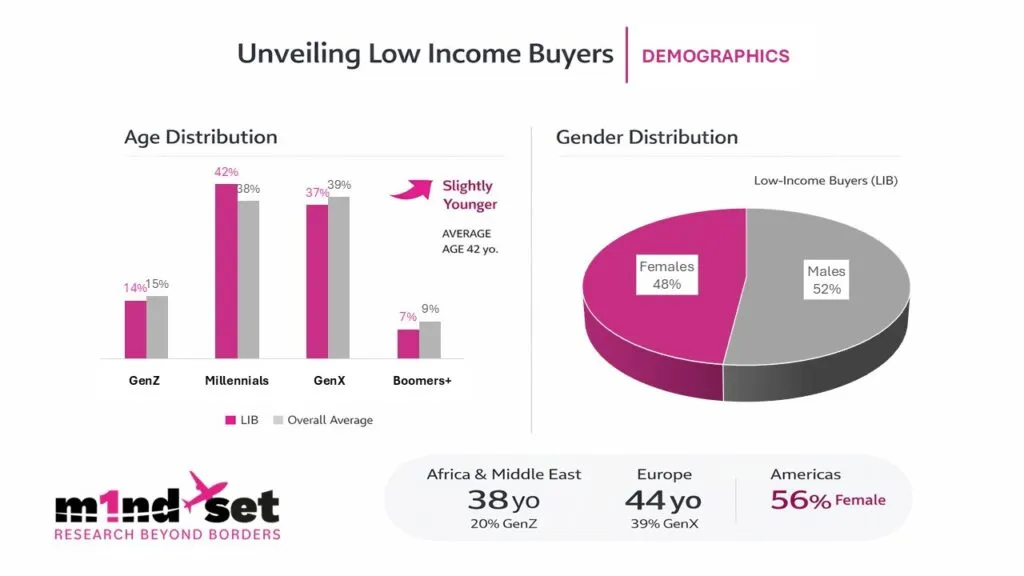
The research reveals that while LIBs are slightly less likely to enter a duty free store, once inside they convert more efficiently than other segments and demonstrate above-average engagement with digital touchpoints, innovation and sales staff.
m1nd-set CEO & Owner, Peter Mohn said: “Low Income Buyers are often misunderstood in travel retail. The data clearly shows that this is not a low-value audience. While they may be slightly less likely to enter a store, once inside they are the most efficient converters, with a higher conversion rate versus the other segments.”
Demographically, LIBs skew slightly younger than the global average, driven by a higher proportion of Millennials and a marginal underrepresentation of Boomers+. Millennials account for around 42% of LIB shoppers globally, compared to 38% across all duty free shoppers. Regional differences are pronounced, with Africa & the Middle East hosting the youngest LIB profiles at an average age of 38, while the Americas show a notably stronger female skew than the global average.
According to m1nd-set, LIBs are the most digitally aware shopper segment in global Duty Free. Digital touchpoints are their strongest awareness driver, outperforming both airport media and inflight channels. More than half of LIBs notice digital touchpoints pre-trip, the highest rate of any segment. However, they are also the least planning-oriented shoppers, with only around two-thirds planning purchases in advance. This results in the highest impulse purchase rate of any segment, at 34%.
This combination of digital awareness and spontaneity is driving strong performance in discovery and innovation. LIBs outperform the global average for both first-time purchases and Duty Free exclusives, with 65% purchasing either a travel retail exclusive or a unique product.
Human interaction is also a critical factor in driving conversion. More than 55% of LIBs engage with sales staff, the highest interaction rate of any shopper segment. Of these interactions, 75% positively influence purchase decisions, 29% lead to a change from the shopper’s original intended product and 17% state they would not have purchased at all without staff input.
“The income label masks a very strategic mindset,” Mohn continued. “This is a highly selective shopper; their spend reflects quality, usefulness and relevance rather than volume.”
While LIBs purchase the same average number of categories per transaction (1.6) as the broader shopper base, their performance is driven by a strong appetite for discovery and channel exclusivity. The segment leads the market in first-time purchases and shows a preference for travel retail exclusives and higher-value products across categories such as Electronics, Watches, Skincare, Alcohol, and Souvenirs & Gifting.
“Efficient conversion, high-quality spend, digital fluency, and openness to innovation make LIBs a segment that punches well above their weight in driving performance,” Mohn continued.
“The Low Income Buyers segment are driven by what we call an ‘efficiency paradox’. They enter duty free shops to save money, but those perceived savings act as a catalyst for higher-value spending. Combined with the airport’s unique psychological ‘re-composure zone’, this creates a shopper who is highly spontaneous, open to discovery, and extremely responsive to staff advice. Far from being low-value, LIBs are one of Duty Free’s most underestimated growth drivers because they spend strategically, selectively, and make the most of the travel retail environment,” Mohn concluded.
link